7 May 2021
Dear sirs,
This is a motion for a rehearing under RSA 677-2 of the Variance Case #13-2020 (originally scheduled for 1 December 2020, rescheduled for 5 January 2021 so that – upon information and belief – the Planning Board would have enough time to propose a special purpose warrant article for the benefit of Mr. Duquette, rescheduled a second time for 6 April after the Planning Board voted on the special purpose warrant article, and rescheduled a third time for 4 May when the special purpose Warrant Article was decisively rejected by the voters).
There are multiple reasons that the variance hearing on 4 May 2021 was invalid, including but not limited to
- improper application by Mr. Duquette
- failure to meet the burden of production by Mr. Duquette
- lack of familiarity with the ZBA manual by the ZBA
- improper refusal to consider Cease & Desist by the ZBA
- refusal to be bound by NH Supreme Court precedent by the ZBA
- refusal to use the “burden of persuasion” standard by the ZBA
- violations of due process by Mr. Dearborn, to the advantage of Mr. Duquette
- violations of due process by Mr. Dearborn, to the disadvantage of myself
- refusal to consider evidence by Mr. Dearborn
- mishandling of evidence and lack of procedures re evidence by Mr. Dearborn
- lack of consistent metrology standards by the ZBA
- improper voting procedure: method of voting by the ZBA
- improper voting procedure: time, research, and deliberation
- failure to understand how “personal circumstances” differs from “characteristics of the parcel”
- failure to comply with RSA 91-A by Mr. Dearborn and others
- failure to recuse by Mr. Dearborn
- the variance hearing was yet another attempt by Mr. Dearborn to relitigate his flawed understanding of article 3.5.1
- improper site visits by the ZBA
- improper second variance hearing by the ZBA
1: Improper Application
Item six on the required document checklist for a variance application states “Applications must identify the type of variance being applied for, use or area. Applications that do not contain this SHALL NOT be reviewed by the Board”. The Duquettes’ application does not specify the type of variance. The application should have been rejected.
Item four on the required document checklist states “Improperly completed applications shall be rejected … if you are seeking relaxations from setbacks…a professional stamped plan shall be mandatory.” The Duquettes’ application does not include a professional stamped plan. It should have been rejected. Even if the application was not for a relaxation from setbacks, the required plan must be “well drawn” and “in scale”, and the pencil sketch in the application is neither. The application must be rejected.
Mr. Dearborn, the chairman of the ZBA, clearly understands that applications must be completed correctly, and that incorrectly filled out applications must be rejected. We know this because he said so, at a different meeting. On 6 April 2021 at 7:20 Mr. Dearborn said
“The next case we have for a continuance, and the reason is an issue with the application…so we’d like… the applicant, to update [ the application ]… It should have been picked up at the processing of the application…It wasn’t, it got through, and I picked it up.”
It’s good that the town has two levels of scrutiny of applications, and it’s good that Mr. Dearborn correctly rejects incorrectly completed applications (at least some times).
…but that does raise the puzzle of why Mr. Dearborn allowed the application for the variance at 271 Quaker street to be accepted and acted upon when he was told, three times, in writing, that the application was deficient and did not meet the ZBA’s own rules.
(The three times Mr. Dearborn received the point in writing were were
- in person on 8 Dec 2020
- on 8 Dec 2020 with USPS tracking number 7020-0090-0001-6212-3971
- on 6 Apr 2021 via USPS tracking number 7020-2450-0000-2704-0209
)
My Dearborn attempts to escape the question by just flatly contradicting the premise, going on record at 1:21:40 and falsely stating that
“We’re here this evening because it’s a properly filled out variance.”
The ZBA has not – in the intervening five months – responded to the objection, rejected the application, nor required that it be revised, and so we are left with a mystery: why do some variance applicants have their applications rejected for rework (as with the 6 April 2021 case) while others are allowed to proceed to the variance hearing, have their variance applications blessed as “properly filled out” when they are not, and even have variances issued?
To be clear, there are two distinct issues here:
- the application for a variance at 271 Quaker Street was incomplete and should have been rejected
- Mr. Dearborn uses different standards when evaluating applications from people he is friendly with, allowing them to avoid the expense of conforming to the law, thus demonstrating bias
The town lawyer should explain to Mr. Dearborn that he is not allowed to exempt applicants that he is friendly to from the rules, and a second hearing should be held to remedy the flaws in the hearing of 4 May 2021, and the variance should be immediately denied for not being valid.
2: failure to meet the burden of production
The burden of production is defined as “a party’s obligation to come forward with sufficient evidence to support a particular proposition of fact.” ( https://www.law.cornell.edu/wex/burden_of_production )
In order for the ZBA to issue a variance, the applicant bears the burden of persuasion, but before even that, he must bear the burden of production: presenting evidence to support each of the five prongs of the variance test.
As I pointed out in writing on 5 January 2020, in writing on 6 April 2021, and verbally during the 4 May 2021 variance hearing, Mr. Duquette did not provide coherent or relevant answers to any of the questions on the variance application.
It was Mr. Duquette’s duty to fill out the variance application, and it was the ZBA’s duty to hold him to that standard. The ZBA failed in its duty.
Note further that the ZBA has had my document for months which explained that Mr. Duquette’s answers were non responsive and effectively blank, and thus failed the burden of production. There was no excuse for the ZBA to not understand this issue and rule correctly.
Zoning Boards of Adjustment are governed by law and the State of New Hampshire. The State publishes a handbook, “The Zoning Board of Adjustment in New Hampshire”, which defines the powers of the ZBA, the limits on those powers, and the procedures to legally execute those powers.
The ZBA should read the ZBA handbook and understand what the questions on the variance application mean and what burden of production entails, and a second hearing should be held.
(Note that such a hearing absolutely requires denial because the burden of persuasion can not be met by the Duquette’s nonresponsive answers to each prong).
3: lack of familiarity with the variance process and the ZBA manual by the ZBA
During the variance hearing I made reference to “the ZBA manual” and Mr. Dearborn expressed confusion and befuddlement as to what manual I might possibly be talking about. This can be see in the video at 54:00
Corcoran: “This is in the current copy of the manual for the zoning board.”
Dearborn: “Whose manual?”
Corcoran: “The state of new hampshire.”
Dearborn: “It’s the friendly advice to help people manual?”
If Mr. Dearborn is to be taken at his word, this is evidence that he is unfamiliar with “The Board of Adjustment in New Hampshire: A Handbook for Local Officials”, which is the first search engine hit for “nh zba manual”, and which is available at nh.gov.
If Mr. Dearborn is telling the truth, and I see no reason to doubt that he is, then he effectively admitted that he has not read the state issued manual that defines the ZBA’s powers, the limits on those powers, and the procedures to legally execute those powers.
Given that Mr. Dearborn does not know how variance procedures work, the variance procedure he presided over was inherently flawed.
Mr. Dearborn and others should read the ZBA manual and a second hearing should be held, and a second hearing should be held to remedy the flaws in the hearing of 4 May 2021.
4: improper refusal to consider the existence of a Cease & Desist order
During the variance hearing the Duquettes explained that the reason they wanted a variance, despite having other legal places that they could build the structure, was that they had already built the structure.
I raised the point that the structure had been built in violation of a Cease & Desist order. Mr. Dearborn objected to this, stating that he had no information about any cease and desist order.
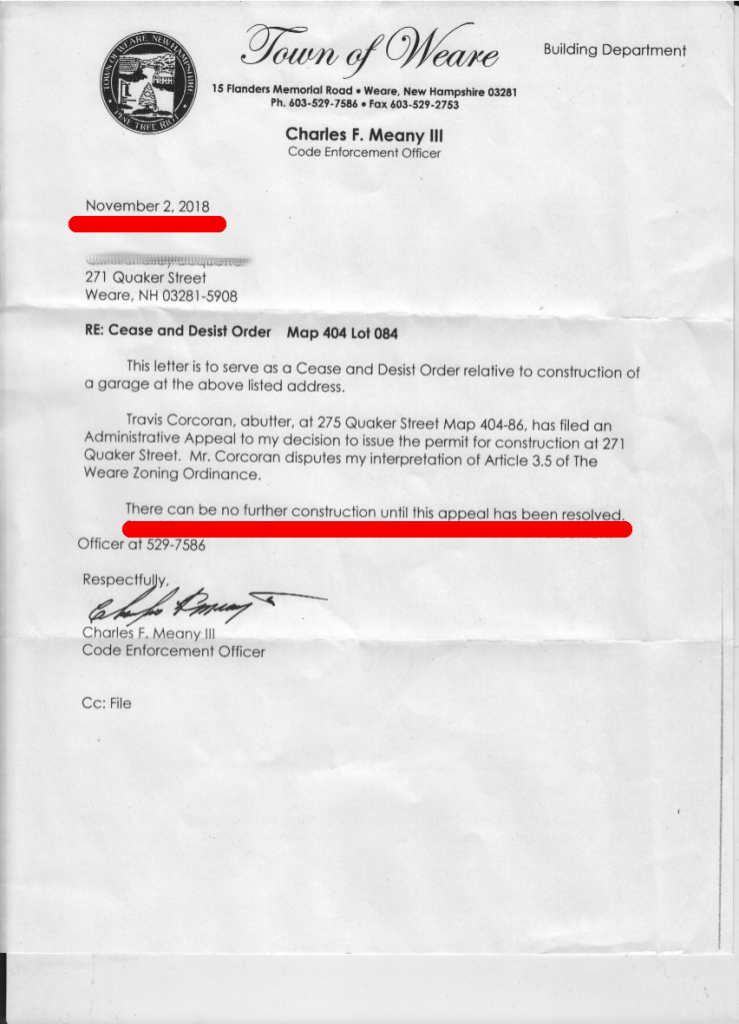
Mr. Dearborn was in receipt of a document from me on 6 December 2020, when I physically handed it to him at the site visit to 271 Quaker street which explained, in the first sentence, that there was a C&D order.
Mr. Dearborn was in receipt of a document from me on 8 December 2020, when the USPS delivered it to him with tracking number 7020-0090-0001-6212-3971, which explained, in the first sentence, that there was a C&D order.
Mr. Dearborn was in receipt of a document from me on 6 April 2021, when the USPS delivered it to him with tracking number 7020-2450-0000-2704-0209, which explained, in the first sentence, that there was a C&D order.
Mr. Dearborn explained in the variance hearing of 4 May 2021 that he had read the document.
Mr. Dearborn had five months to find out if my claim that a C&D order existed was true, but either refused to do so or knew that it was true and chose to feign ignorance.
When Mr. Dearborn expressed that he was unsure if a C&D order existed, I asserted that it did, and he attempted to refute this by asserting that my claim was “hearsay”.
Public records are an exception to the hearsay rule (at a federal level, this is codified in Rule 803; I leave it to the town’s attorney to find and explain the state level rule to Mr. Dearborn), thus Mr. Dearborn’s claim was false.
Mr. Dearborn and other members of the ZBA should read up on exceptions to the hearsay rule, should review the cease and desist order that the town of Weare issued on 2 November 2018, review the timeline that I have provided them several times now showing that construction of the illegal building began on 4 January 2019 while the C&D was in effect, and should review the court transcript from 15 September 2019 which documented that the violation of the C&D was discussed in court. After the ZBA reads and understands the timeline which has already been provided to them multiple times, a second hearing should be held to remedy the flaws in the hearing of 4 May 2021.
5: refusal to be bound by NH Supreme Court precedent
During the hearing I referenced several New Hampshire Supreme precedents, including
- Crossley v. Town of Pelham, 133 N.H. 215 (1990)
- Ouimette v. City of Somersworth, 119 N.H. 292 (1979)
- Garrison v. Town of Henniker No. 2005-471 (2006)
- Maureen Bacon v. Town of Enfield, 150 N.H. 468 (2004)
Mr. Dearborn, advocating for the variance petitioner, challenged my use of these cases, stating that these were old cases, that the law had changed, and implying that these precedents were not dispositive to the case at hand.
Mr. Dearborn presented zero evidence for his claims.
In fact, all of these cases were taken directly from the ZBA manual (“The Board of Adjustment in New Hampshire: A Handbook for Local Officials”), and they are still good case law.
I charitably attribute Mr. Dearborn’s ignorance of the legal standing of these cases to the fact that he apparently did not read the document I handed him six months ago, nor is he – according to his own words in the 4 May 2021 meeting – familiar with the ZBA manual from which those cases are drawn.
Additionally, another ZBA member stated, just before the vote on the variance, that the ZBA should not be and was not bound by precedent, as they were voting on one particular variance, and thus the cases selected by the state of New Hampshire to elucidate the laws of New Hampshire were not relevant to the ZBA’s application of the laws of New Hampshire to a variance case in the state of New Hampshire.
This can be seen in the video at 1:29:00 when board member Michael Meyer says
“prior cases aren’t relevant in my opinion. This is all about this variance request … this is all about whether the Duquettes are meeting their … five points of hardship”.
(As a side note, Mr. Meyer’s confusion over the five prongs of the variance test, asserting that there are five tests for hardship, instead of understanding that there is one test for hardship with two sub-prongs, and four other tests for distinct aspects of the property that are unrelated to hardship, may explain why his votes were in no way plausibly derived from or in conformance with the methodology that the ZBA manual specifies.)
It is hard to understand how any one who has read the ZBA manual, which explains on page after page after page how prior New Hampshire court rulings are relevant, could possibly think such a thing.
Mr. Dearborn and other members of the ZBA should read the ZBA manual, which was updated approximately twenty days ago in March 2021, to assure themselves that the precedents I cited are still good case law and are still all cited by the ZBA manual. The members of the ZBA should then read the judgements in each of these cases, as I have, so that they can understand the laws that they are charged with executing, and a second hearing should be held to remedy the flaws in the hearing of 4 May 2021.
6: refusal to use the “burden of persuasion” standard
The ZBA manual explains on page II-12 that the applicant for a variance has the burden of persuasion on all five prongs of the variance test.
As I pointed out in my testimony, the applicant did not present any evidence what-so-ever for any of the five prongs, and thus failed to carry the burden of persuasion.
Mr. Dearborn refused to apply this standard.
Mr. Dearborn and other members of the ZBA should read the ZBA manual to understand the “burden of persuasion” standard, and a second hearing should be held to remedy the flaws in the hearing of 4 May 2021.
7: violations of due process by Mr. Dearborn, to the advantage of Mr. Duquette
At several times during the hearing Mr. Dearborn helped Mrs Duquette find her words, rephrased her claims, put words in her mouth, and generally acted as an advocate for the applicant.
For example, at 16:06 he helpfully adds to and extends her testimony re prong 1:
“And, obviously, a garage is a compliant use for a residential lot?”
to which Mrs Duquette, grateful for his help, enthusiastically agrees
“Yes!”
Mr. Dearborn also helps out Mr. Duquette at 1:16:15, lobbying a leading softball question, in an attempt to generate the testimony he wants to hear (that it would be cost prohibitive to site the building on the east of the property):
“He [ Corcoran ] spent a lot of time, highlighting other locations…what’s your opinion on that, as far as a cost issue?”
Unfortunately for Mr. Dearborn and his attempt to lead the applicant into the “correct” answer which would help Mr. Dearborn justify a hardship prong, Mr. Duquette, even being fed breadcrumbs, failed to come up with the answer Mr. Dearborn wanted:
“We would have to walk up a hill to get from our garage… most people want a garage somewhat close to their house, so they can bring in their groceries.”
Mr. Dearborn should have the concept of due process explained to him by the town attorney, and a second hearing should be held to remedy the flaws in the hearing of 4 May 2021.
8: violations of due process by Mr. Dearborn, to the disadvantage of myself
Continuously throughout my testimony Mr. Dearborn interrupted me, contradicted me, threatened to cut off my testimony, asserted that because he had misplaced or lost paperwork that I had sent via certified mail that I could not cite certain pieces of evidence, mocked my factual claims, invented false claims out of thin air (e.g. that the margin of error on Google photogrametric data is 20 feet, or that the case law I cited was out of date) and tried a dozen times to steamroller me to get me to prematurely terminate my arguments against the proposed variance.
This is similar to how Mr. Dearborn argued, from his position as chair of the ZBA, against me and cut off my testimony on the same matter, during the 4 December 2018 appeal of administrative decision.
Mr. Dearborn should have the concept of due process explained to him by the town attorney, and a second hearing should be held to remedy the flaws in the hearing of 4 May 2021.
9: refusal to consider evidence
I tried to introduce into the record a survey of 271 Quaker Street, and also information from that survey – the location of the illegal structure at 271 Quaker Street.
Mr. Dearborn objected, saying that he did not have a copy of it, and suggesting that it was illegitimate for the ZBA to acknowledge the survey or the setback distances mentioned in it.
Mr. Dearborn has received the survey and the measurements several times:
- 11 Sep 2020 in the Petitioner’s Memorandum, via an included survey
- 8 Dec 2020, verbally from me, citing the survey
- 8 Dec 2020, in writing, via certified mail
- 29 Dec 2020, in writing, via certified mail, responding to minutes containing the incorrect data that Mr. Dearborn generated
- 10 Mar 2021, in writing, via certified mail
The most recent time, on 10 March, I hopefully wrote in my letter
Despite the town receiving the correct measurements four times now today, a quarter of a year after I reminded the ZBA of the correct measurements, and 1.5 years after the town first received the correct measurements, the false figures remain in the ZBA draft minutes…
Perhaps the fifth time is the charm.
I see now that five times was insufficient.
Perhaps the sixth time will be the charm? I have included yet another copy of the survey to test this hypothesis. Let us see if it is incorporated into the official record this time.
Mr. Dearborn should look at the survey and survey figures that he has been given six times now, and a second hearing should be held to remedy the flaws in the hearing of 4 May 2021.
10: mishandling of evidence and lack of procedures re evidence
I have, at all times, conveyed documents to the BoS and the ZBA via certified USPS mail, and via email.
Both of these methods of conveyance are well established as conforming to RSA 91-A.
In the 4 May 2021 variance hearing Mr. Dearborn asserted that he did not have a survey and did not have the 6 April 2021 version of my variance rebuttal document which included a copy of the appraisal report from Concord Capital Appraisal, and details on the damage done to my driveway by runoff from the illegal building, but only had an earlier version.
When I said that I had emailed them to him, he asserted that that didn’t count.
When I said that I had mailed them via USPS, he said that he hadn’t received them.
When I said that I had USPS tracking codes documenting that the ZBA had received them, he dismissively said that that was “very interesting”, but argued with me and reiterated that he did not have them, and implied that therefore I could not make reference to them.
Later in the meeting Mr. Dearborn mentioned that he had recently visited 271 Quaker Street to inspect the grading and run off issues which were raised by my document.
At this point I explained that those issues were only raised in the 6 April 2021 version of my document, and thus Mr. Dearborn had just confirmed that he had, in fact, received the document that he had earlier claimed to have not received.
Mr. Dearborn rebutted that this was only proof that he had one page of the document.
Another board member stated that she, too, had two copies of the same December 2020 document, and zero copies of the April 2021 document. I note a point here: the five members of the ZBA each had a copy of the document – and yet I had sent only one copy on each date. Obviously someone in Weare town government is making and distributing copies … and made a mistake and copied and distributed the wrong document.
The ZBA clearly has inadequate procedures in place to log and track evidence.
I suggest that the ZBA purchase a three ring binder, a three hole punch, and a “received on date ___” stamp so that they can better organize their records.
I request that Mr. Dearborn find the other pages of the 6 April document that he has misplaced, and – thus equipped – hold a second hearing to remedy the flaws in the hearing of 4 May 2021.
11: lack of consistent metrology standards
This variance process, seeking a relaxation of setbacks, has necessarily introduced several measurements and several maps.
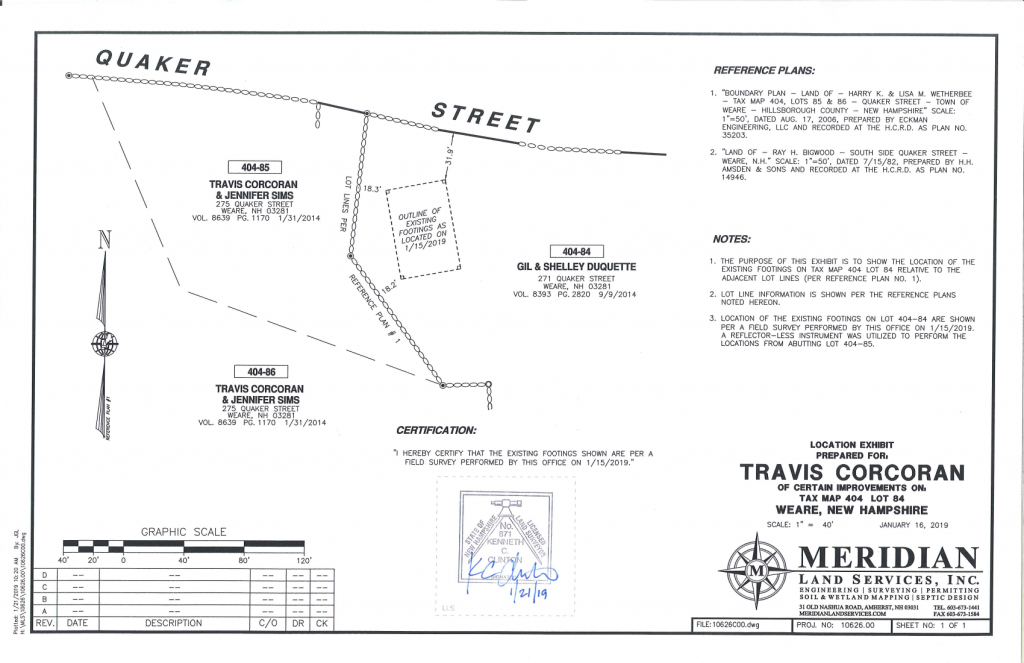
The first set of measurements, derived by a survey by Meridian Land Services and presumably accurate to an inch or less, was ignored five times by Mr. Dearborn.
The second set of measurements, derived by use of a common carpenter’s tape measure by Mr. Dearborn (not, to my knowledge, a certified surveyor), was introduced into the minutes of the ZBA with an implicit claim to precision of 0.2%, as Mr. Dearborn specified intervals to a fraction of an inch.
(In fact, a comparison Mr. Dearborn’s ad hoc carpenter tape measurements and an actual surveyor’s data shows that Mr. Deaborn’s measurements were off by a foot, over a span of less than 20 feet – a very high 5% error which is 25 times worse than his implicitly claimed 0.2% accuracy. Given that Mr. Dearborn’s mis-measurements were to benefit of the variance applicant they are also perhaps suggestive of bias.)
The third set of measurements, introduced by me at the variance hearing, were from various GIS (Geographic Information Systems) including University of New Hampshire’s Granitview, and Google maps. This third set of measurements were challenged by Mr. Dearborn, who suggested – without evidence – that the Google photogrametric data had errors of 20 feet or more, and that the Granitview 2 foot LIDAR survey was likewise off by 20 feet.
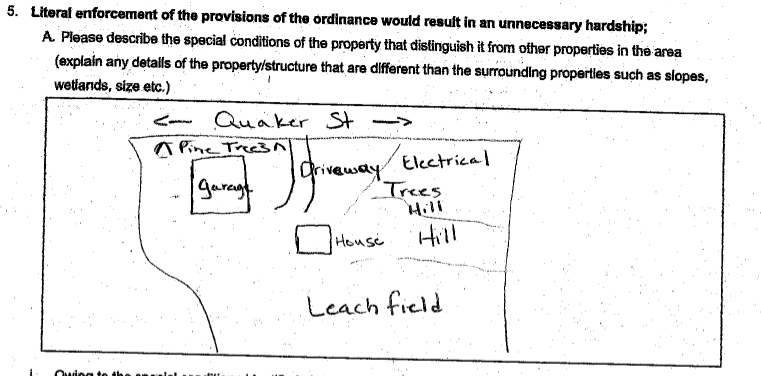
The first map was hand drawn by Mrs Duquette in pencil, with no dimensions. This map was submitted by Mrs Duquette a single time, and was accepted into evidence by the ZBA (despite the ZBA’s own rules that maps for relaxation of dimensional setbacks must be professionally prepared and stamped by an engineer).
The second map was professionally produced by a surveying firm and was stamped by an engineer. Despite being submitted multiple times, this map was never once accepted into evidence.
If Mr. Dearborn had concerns about the accuracy of the measurements from various GIS sources, he could have raised them and sought to verify or disprove them at any time between 24 October 2018, when they were first presented to the ZBA, and the current day. One wonders if, perhaps, Mr. Dearborn actually had no principled objections to the figures nor to their source – but that he merely sought to dispute, disrupt, and challenge them because they are harmful to the argument of the party he favors in the variance hearing.
(As a side note: disapproving abutters do not have the burden of persuasion to show that their figures are correct; the variance applicant has the burden of persuasion, so perhaps Mr. Dearborn should have just accepted my measurements and allowed the Duquettes the opportunity to rebut them with better data, if they had any.)
The ZBA’s practice of refusing to admit or attempting to discredit survey data and GIS data quality, and embracing Mr. Dearborn’s own tape measurements and Mrs Duquette’s pencil maps is inconsistent with good governance and a fair variance process. The ZBA should, in consultation with the town’s attorney, come up with a consistent metrology standard, publish and announce it, and then abide by it. Once the ZBA has done this a second hearing should be held to remedy the flaws in the hearing of 4 May 2021.
12: improper voting procedure: method of voting
Page III-15 of the ZBA handbook states that
Caution should be exercised not to treat the decision-making process merely as a tabulation of votes on the various approval requirements by each member.
and yet this is exactly how the ZBA treated the decision making process, as seen at 1:32:20 in the meeting.
Page III-18 of the ZBA handbook states
When considering the language of variance votes, it is suggested to mimic the language of the statute
(RSA 674:33) as closely as possible…For example: Will granting the variance…
1. Not be contrary to the public interest?
2. Observe the spirit of the ordinance?
3. Do substantial justice?
4. Not diminish the values of surrounding properties?
5. Prevent unnecessary hardship that would be caused by literal enforcement of the ordinance?
The more the board strays from the language of the statute, the more the board might get it wrong and end up having a decision reversed on appeal.
The ZBA failed to follow the suggested language, and instead just called out the prongs by number. This can be see at 1:33:00
“two please”
“move to accept article 2”
“second?”
“second”
“any discussion?”
“all those in favor?”
“aye”
“aye”
“no”
“aye”
“three”
“move to accept article 3”
“second?”
“second”
“all those in favor?”
“aye”
“aye”
“no”
“aye”
and so forth, ending with Mr. Dearborn announcing “based on the results, it passed”, and then briefly smiling.
Given the lack of discussion and the refusal of the ZBA to follow the suggested wording of the variance votes, it’s far from clear that members of the ZBA understand the distinct and unique nature of each of the prongs that they were theoretically voting on (this is corroborated by Mr. Meyer at 1:29:00 who states that there are “five points of hardship”).
As the ZBA manual specifically calls out
The more the board strays from the language of the statute, the more the board might get it wrong and end up having a decision reversed on appeal.
The ZBA should re-read pages III-15 and III-18 of the ZBA handbook, understand the suggesting voting procedure, and then rehear the variance application to remedy the flaws in the hearing of 4 May 2021.
13: improper voting procedure: time, research, and deliberation
Page III-18 of the ZBA manual states
The board does not need to reach a decision on the same night as the hearing was held and can take time to consider the evidence and testimony and render a decision at a later time.
Mr. Dearborn admits at multiple times that the ZBA does not have sufficient data to make a competent decision, and yet he does not delay the decision making (as per page III-18) in order to receive, read, and understand the information.
I’ll call out four examples where Mr. Dearborn admits that he is missing information:
- a survey of 271 Quaker Street
- an appraisal report by Lou Manias of Capital Appraisal Associates
- case law and precedent
- a Cease & Desist order issued by the town of Weare.
13.1 : the survey
At 27:08 Mr. Dearborn states
“Do we have a survey? I haven’t seen it.”
At 27:39 he falsely states
“We have not received it.”
At 28:00 the town administrator says
“Yes, Jack, I have it.”
to which Mr. Dearborn responds at 28:05
“Well, we don’t have it, so I don’t know what it says.”
and elaborates at 28:22
“I don’t think any members have it. I didn’t know it existed. So I’m just saying that’s how I don’t know it.”
And again at 29:22
“Did anyone else get a copy of that? No.”
If Mr. Dearborn actually wanted the survey, he could have delayed the vote to give him an opportunity to search his records and find any of the various copies that I’ve mailed the ZBA.
Mr. Dearborn did not delay the vote, showing that he was not actually interested in viewing the survey.
13.2 : the appraisal
Regarding data from Capital Appraisal, Mr. Dearborn misplaced part or all of the document I sent to the ZBA, had not read it, and did not have the facts about diminuition of value in front of him. He states this at 42:39:
“Wait, where is that? Are you just reading that? … Are you going to hand us a copy of that?”
To which I responded
“I have a USPS tracking number showing that it was received.”
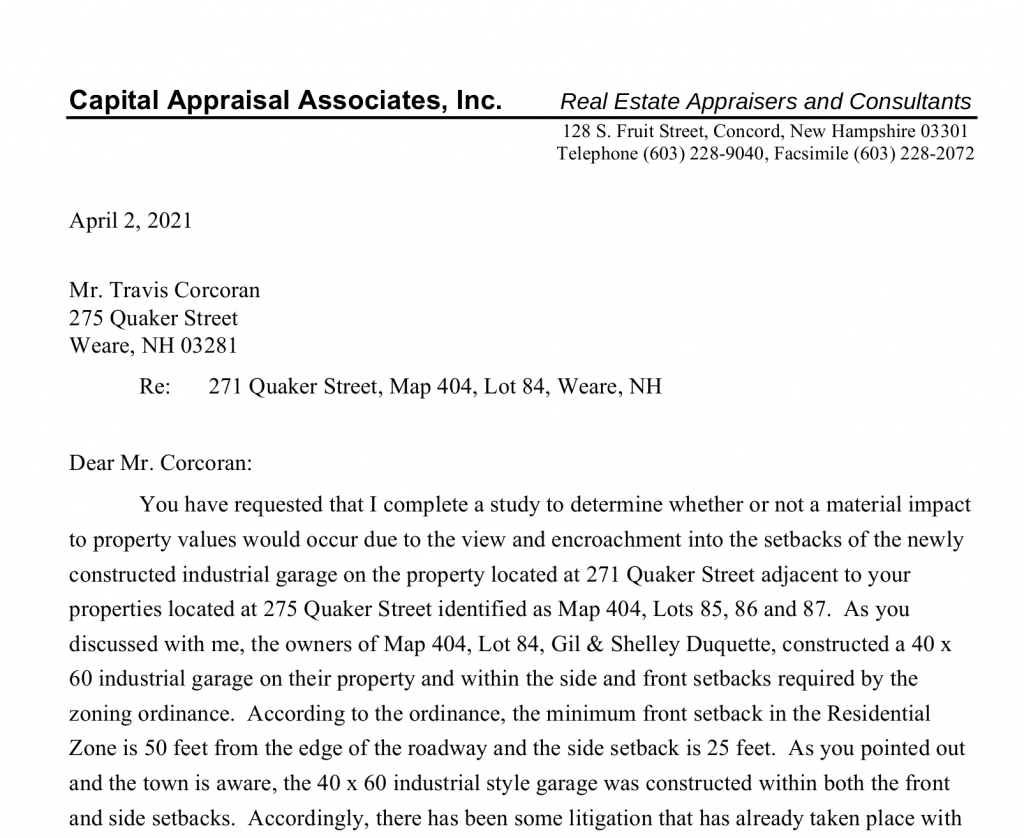
To which he said
“I don’t see these percentages. … you put a bunch of percentages out there and I don’t see that information… I just need to make sure that it’s factual.”
I understand his desire to inspect the evidence “to make sure that it’s factual”. If the appraisal I was quoting was real, then it sinks prong 4 of the variance application, and thus the variance could not be issued.
I offered at 44:34
“Would you like me to take 60 seconds to email you a copy of the report?”
Mr. Dearborn responded
“No.”
indicating that he was not interested in relevant data.
Mr. Dearborn could have delayed the vote to allow him to find the misplaced documents, but he did not, showing that he was not actually interested in learning about the diminution of property values.
13.3 : case law and precedent
At 53:00 I cited Crossley v. Town of Pelham, 133 N.H. 215 (1990).
Mr. Dearborn interrupted me and said
“there’s a problem there because the criteria for variances changed significantly in 2010…I’m suggesting that the cases you may have been citing may have been overcome by events”.
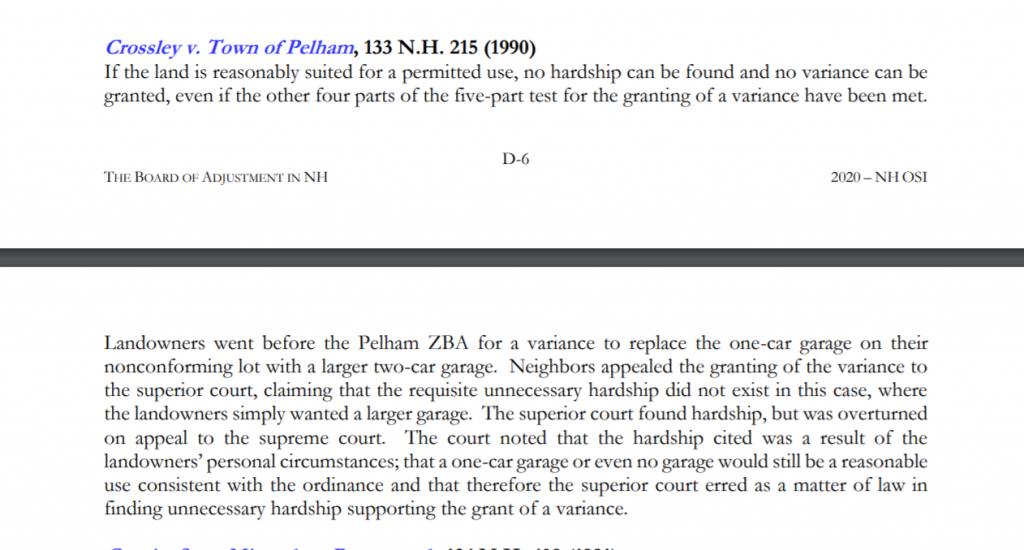
Mr. Dearborn raises a relevant issue: is the case I cited still good law? The ZBA definitely deserves an answer to that question, because if the case is still good law, then it entirely sinks prong 5 (hardship) and thus sinks the variance application.
If Mr. Dearborn actually wanted an answer to that question to help him vote in accordance with the law, he could have delayed the vote to give him an opportunity to read the ZBA handbook or consult with the town attorney.
Mr. Dearborn did not delay the vote, showing that he was not actually interested in learning about controlling precedent.
13.4 : the Cease & Desist order
Regarding the cease and desist order, at 1:19:22 Mr. Dearborn states
“I don’t think we have the facts here tonight”.
Board member Malcolm Wright responds
“Why don’t we have the facts? This is a matter of our code enforcement officer either issuing something [ a Cease & Desist ] or not. We should have the facts.”
Mr. Dearborn responds
“Unfortunately that person is not here to ask the question [ of ]. It’s an interesting question, but”
and then he shrugs.
Mr. Wright correctly responds
“I think it’s very key….it’s very important. Was there a Cease & Desist order, and was it violated? …I think it’s very relevant to the hardship. I’ve seen a lot of cases where the applicant has created their own hardship and then claimed it as a hardship, and that seems to be what’s going in…. and I don’t know if that’s true. And that’s why I want to know if this Cease & Desist order truly exists and if it was violated. That is something that should have come from our code enforcement officer, and it has a very strong bearing on this case.
At 1:22:59 I asked Mr. Dearborn
“Is my camera working?”
he responded
“Yes.”
I then held up the Cease & Desist order to the camera and stated
“Here’s a copy of the Cease & Desist, dated 2 November 2018, and I can read out the timeline.”
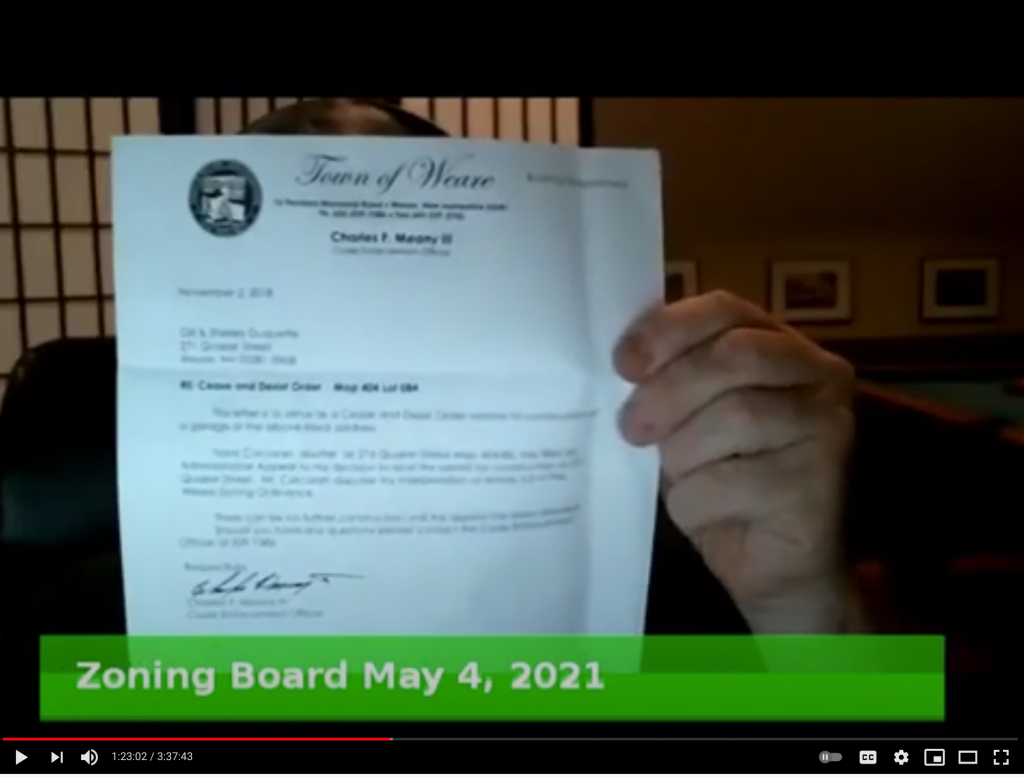
Mr. Dearborn, clearly annoyed to have his narrative that there is no proof of a Cease & Desist order disrupted, says
“It’s an interesting point, but…”
and then shrugs.
Mr. Dearborn then spies a way to get out of the losing position that he, as an advocate of the variance applicant, has found himself in and asks
“Does it ever say if it was ever lifted?”
I responded
“It was never lifted.”
Mr. Dearborn responded
“So we don’t have any information on that either, so.”
This is apparently said in an attempt to somehow neutralize the topic of the Cease and Desist, as if my failure to show him a document that doesn’t exist somehow balances his failure to have been aware of a document that does exist.
Mr. Dearborn best expresses his desire to race to a conclusion and issue the variance at 1:21:40 when he says.
“Well, we’re here this evening…but I think it’s a question of where this thing has a long beard on it…and the board will hopefully make a decision this evening.”
Why, exactly, does Mr. Dearborn hope that the board makes a decision the same night? Mr. Dearborn had three times earlier delayed the variance hearing when it was to the advantage of the applicant, but now when a delay might allow the ZBA to inspect evidence that Mr. Dearborn does not wish it to inspect, he pushes for a speedy conclusion.
This is in contradiction to the advice on page III-18 of the zoning manual, any sense of prudence, and any semblance of due process.
The ZBA should re-read page III-18 of the ZBA handbook, it should get its files in order, it should read and digest the and then it should rehear the variance application to remedy the flaws in the hearing of 4 May 2021.
14: failure to understand how “personal circumstances” differs from “characteristics of the parcel”
At 1:21:25 Mr. Dearborn states
“Irrespective of whether there was or was not a Cease & Desist, the Duquettes have a due process to come before the zoning and ask for a variance”
This betrays a deep misunderstanding of the purpose and mechanism of the variance process. Citizens do not have a right to apply for or receive a variance merely because they want to be unconstrained from the zoning code (which seems to be Mr. Dearborn’s stance), but only in a very limited set of circumstances. The courts have repeatedly drawn the distinction between “characteristics of the parcel” and “personal circumstances”.
The ZBA manual explains on page II-12 that
The courts have emphasized in numerous decisions that the characteristics of the particular parcel of land determine whether or not a hardship exists.
and on page D-7
The superior court found hardship, but was overturned on appeal to the supreme court.
The court noted that the hardship cited was a result of the landowners’ personal circumstances
In the Duquettes case, their desire for a variance is entirely because of personal circumstances (the circumstance they placed themselves in by choosing to violate the Cease & Desist) and not at all from characteristics of the parcel.
Mrs Duqette explained this in the meeting at 14:50:
“We are requesting the variance to allow us to keep the building where it is, because we had built in on the initial permit.”
Mr. Duquette explained this again at 1:16:00 of the meeting, acknowledging that it would have been possible and affordable to build his building on the eastern side of the property line, inside the setbacks, but that he didn’t want to because he didn’t want to carry groceries from that location to his house.
Mr. Duquette further explains a minute later the core reason for his request for a variance: it is not that there are no legal locations for the structure, but because he as already built the building [ in violation of the Cease & Desist ] and now he needs a variance to legalize the existing building:
“We put it there because we asked and that’s where we were given permission to put it. So that’s why it went there.”
Mr. Duquette states it clearly: he needs a variance not because of the characteristics of the land (a valid reason to issue a variance), but because the illegal structure is already constructed, in violation of a Cease & Desist.
I had anticipated that members of the ZBA would not have read or retained pages II-12 and D-7 ahead of time, and thus I made sure to explain the distinction at 53:17
The supreme court noted that the hardship cited was a result of the landowners’ personal circumstances…and that therefore the superior court erred as a matter of law in finding unnecessary hardship supporting the grant of a variance.
Mr. Dearborn did not want the ZBA to hear my explanation that hardship caused by personal circumstances can not justify a variance, and so he interrupted me and asserted (incorrectly, and with no evidence cited) that my case law was out of date.
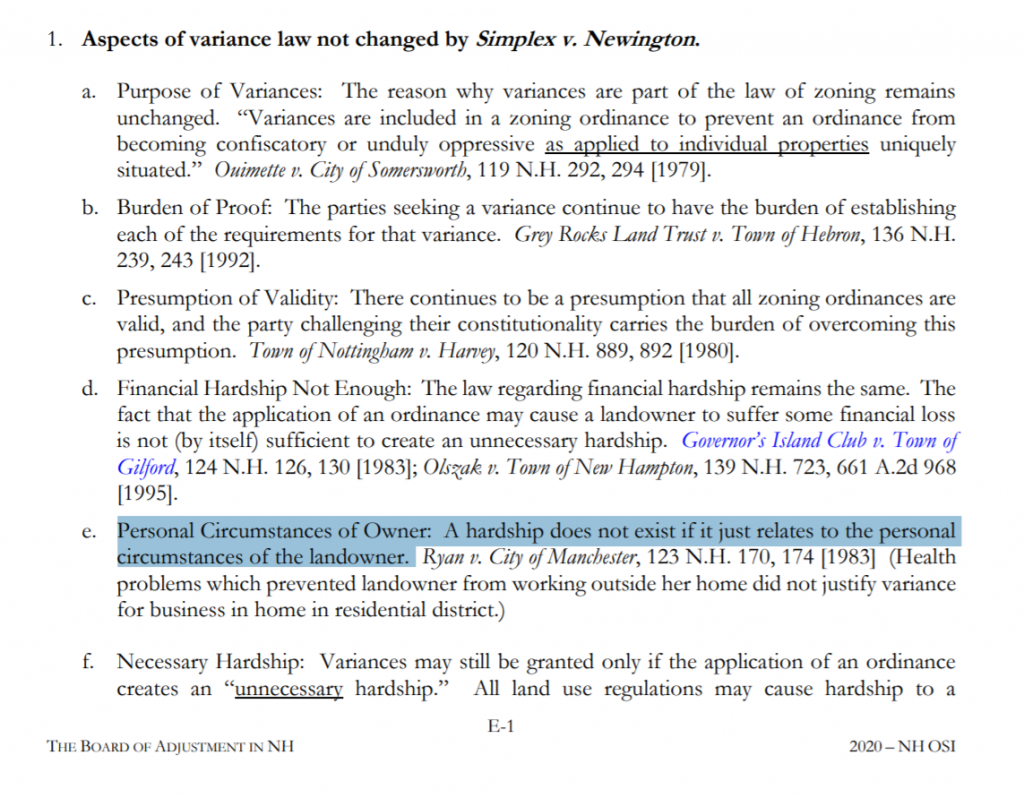
The town lawyer should explain the distinction between hardship caused by personal circumstances and hardship caused by aspects of the land to Mr. Dearborn, and make very clear that the former can not justify a variance, and then a hearing should be held to remedy the flaws in the hearing of 4 May 2021.
15: failure to comply with RSA 91-A
On 22 January 2021 the ZBA received an RSA 91-A request for emails relating to the lawsuit re the improperly granted building permit. Public records that could explain the motivation of the ZBA, the discussions around the now-defeated warrant article 4, the sham site visit of 8 December 2020, and how the Duquettes but not the Corcorans were informed of the proposed warrant article, and more, should have been provided within five days. The ZBA did not provide the records, and instead asserted – via the town administrator – that using the “search” function in an email client would take as long as two months.
Three and a half months later the ZBA still has neither turned over all relevant emails, nor stated on the record that there are no such emails.
In fact, we know that there are missing emails, because one member of the planning board, Bruce Fillimore, has stated in writing that he exchanged emails with Mr. Dearborn on a certain topic, but those emails have not been provided.
This violation of both RSA 91-A and the permanent injunction of Wearepowerful vs the Town of Weare Doc. No. 216-1994-E-182 (Hillsborough Super. Ct. North, December 16, 1994) (Lynch, J.) has hampered my ability to know all of the facts motivating the ZBA and thus to prepare an adequate rebuttal of this variance application.
The ZBA should comply with RSA 91-A without delay, and then a second hearing should be held to remedy the flaws in the hearing of 4 May 2021.
16: Failure to Recuse
RSA 673:14 says any ZBA member who has a conflict of interest must recuse himself. RSA 500-A:12 explains the tests to determine this.
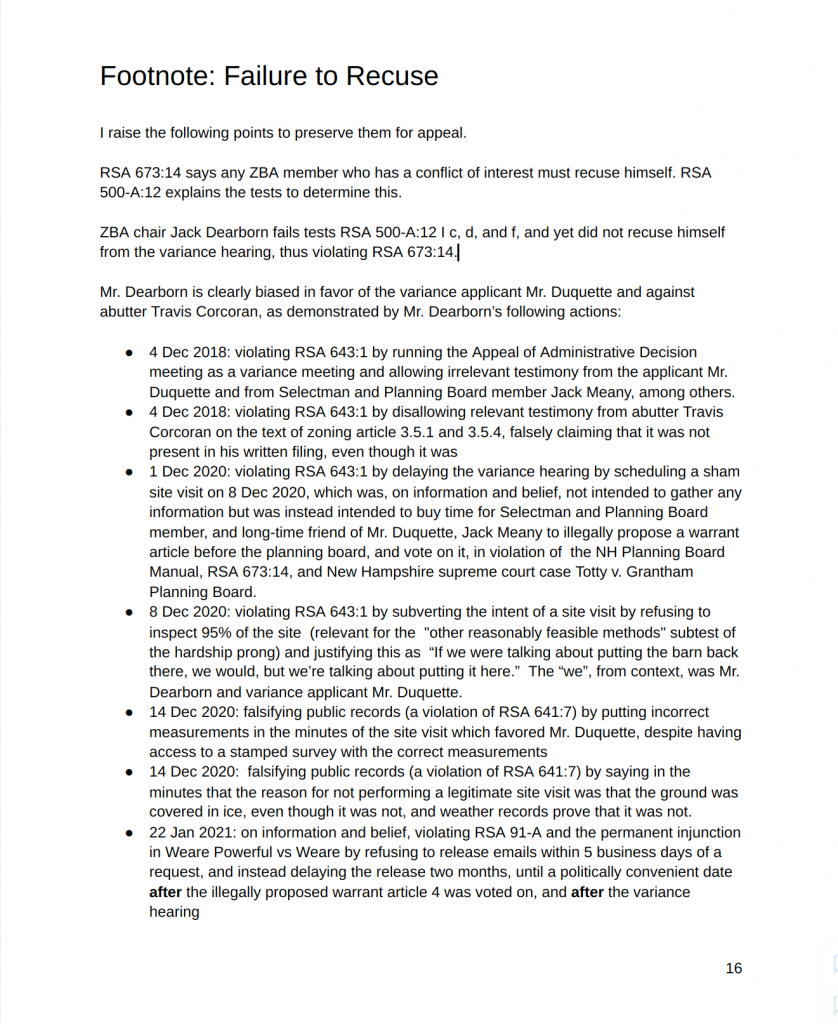
ZBA chair Mr. Dearborn fails tests RSA 500-A:12 I c, d, and f, and yet did not recuse himself from the variance hearing, thus violating RSA 673:14.
(I note that failure to recuse is far from an uncommon problem when it comes to Weare’s town government and land use issues – the recently defeated Warrant Article #4 which, upon information and belief was introduced to help Mr. Duquette in this very case – was pushed forward by and voted on Mr. Meany of the BoS and Planning Board, who had previously, in Dec 2018 at an earlier ZBA meeting expressed his desire to see Mr. Duquette build his structure in the setbacks and who – quoting Mr. Carrera at a previous BoS meeting – is a friend of Mr. Duqette’s. )
Mr. Dearborn is clearly biased in favor of the variance applicant Mr. Duquette and against abutter Travis Corcoran, as demonstrated by Mr. Dearborn’s following actions:
- 4 Dec 2018: violating RSA 643:1 by running the Appeal of Administrative Decision meeting as a variance meeting and allowing irrelevant testimony from the applicant Mr. Duquette and from Selectman and Planning Board member Mr. Meany, among others.
- 4 Dec 2018: violating RSA 643:1 by disallowing relevant testimony from abutter Travis Corcoran on the text of zoning article 3.5.1 and 3.5.4, falsely claiming that it was not present in his written filing, even though it was
- 1 Dec 2020: violating RSA 643:1 by delaying the variance hearing by scheduling a sham site visit on 8 Dec 2020, which was, on information and belief, not intended to gather any information but was instead intended to buy time for Selectman and Planning Board member, and long-time friend of Mr. Duquette, Mr. Meany to illegally propose a warrant article before the planning board, and vote on it, in violation of the NH Planning Board Manual, RSA 673:14, and New Hampshire supreme court case Totty v. Grantham Planning Board.
- 8 Dec 2020: violating RSA 643:1 by subverting the intent of a site visit by refusing to inspect 95% of the site (relevant for the “other reasonably feasible methods” subtest of the hardship prong) and justifying this as “If we were talking about putting the barn back there, we would, but we’re talking about putting it here.” The “we”, from context, was Mr. Dearborn and variance applicant Mr. Duquette.
- 14 Dec 2020: falsifying public records (a violation of RSA 641:7) by putting incorrect measurements in the minutes of the site visit which favored Mr. Duquette, despite having access to a stamped survey with the correct measurements
- 14 Dec 2020: falsifying public records (a violation of RSA 641:7) by saying in the minutes that the reason for not performing a legitimate site visit was that the ground was covered in ice, even though it was not, and weather records prove that it was not.
- 22 Jan 2021: on information and belief, violating RSA 91-A and the permanent injunction in Weare Powerful vs Weare by refusing to release emails within 5 business days of a request, and instead delaying the release for months, until a politically convenient date after the illegally proposed warrant article 4 was voted on, and after the variance hearing
I raised my concerns about Mr. Dearborn’s lack of impartiality in writing on 1 December 2020 and 6 April 2021 but Mr. Dearborn refused to recuse himself.
The flawed variance hearing on 4 May 2021, where Mr. Dearborn spoke over me, disputed my facts without basis, repeatedly threatened to terminate my testimony, refused to introduce written documents into evidence, and more, is proof that my concerns about Mr. Dearborn’s lack of impartiality were, if anything, understated.
Mr. Dearborn’s refusal to recuse himself rendered the 4 May 2021 facially invalid. At the very least, Mr. Dearborn should recuse himself, but ideally all three of the ZBA members who voted in the positive on all five prongs, and thus demonstrated their lack of understanding of the standards for issuing a variance, should voluntarily resign, the BoS should appoint new members, those new members should read “The Board of Adjustment in New Hampshire: A Handbook for Local Officials”, and the reconstituted ZBA should rehear the variance application to remedy the flaws in the hearing of 4 May 2021.
17: the variance hearing was yet another attempt by Mr. Dearborn to legislate his flawed understanding of zoning article 3.5.1
Mr. Dearborn and other town officials (building inspector Chip Meaney, etc.) have a history of refusing to admit the clear text of Weare zoning article 3.5.1 This is documented, among other places, in a 12 October 2018 letter from the building department, in Mr. Dearborn’s statements in the 4 December 2018 ZBA meeting, and in Mr. Dearborn’s statements in other recent ZBA meetings.
In short, a few town officials want the zoning code to have setbacks of 30′ (front) and 15′ (side) for all structures on non-conforming lots, even though this is not what the zoning code approved by the voters specifies.
Mr. Dearborn’s insistence on these fictional folk setbacks should have ended – but did not – in the town’s defeat in TRAVIS CORCORAN, ET AL, Plaintiffs, vs. TOWN OF WEARE ZONING BOARD OF ADJUSTMENT, ET AL, Defendants.
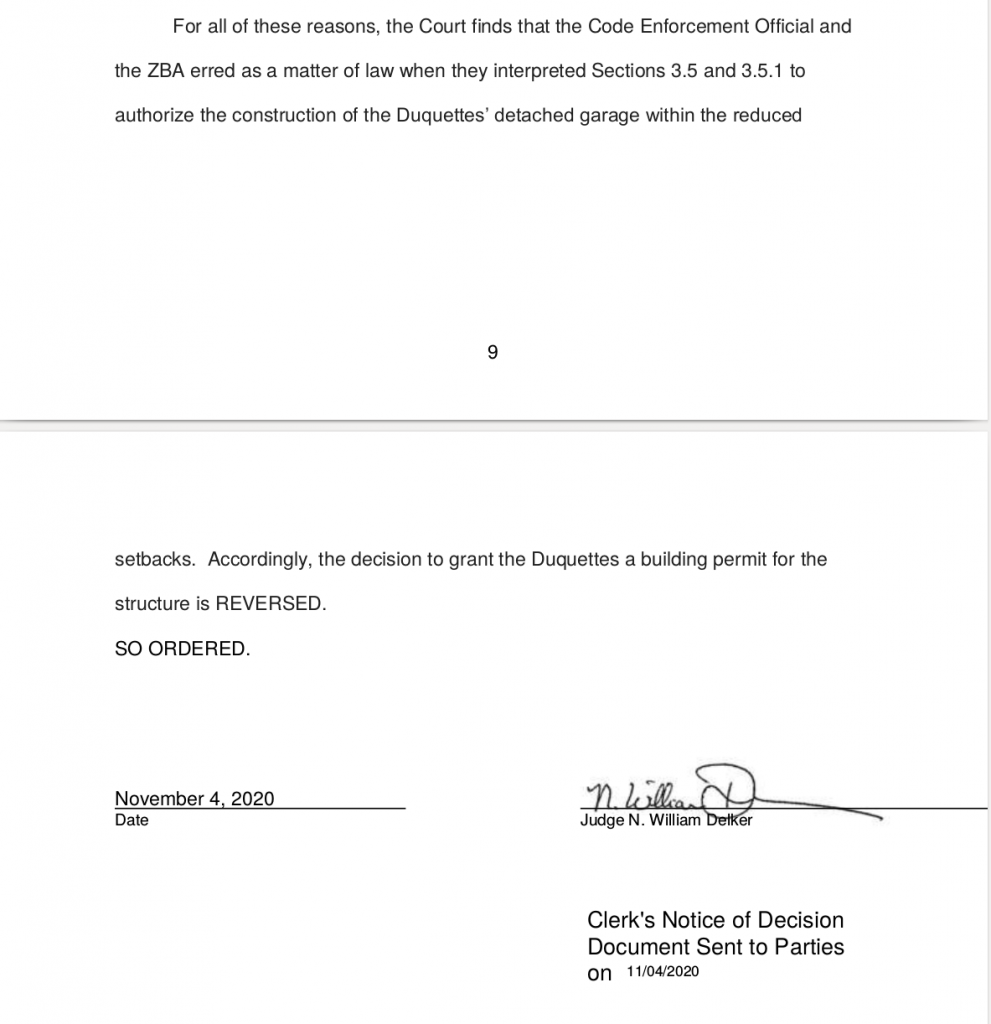
After that court loss certain members of the Planning Board, upon information and belief, engaged in a coordinated attempt with Mr. Dearborn and the variance applicants at 271 Quaker St to change the zoning code to make it conform to the Mr. Dearborn’s original flawed understanding (in passing, this action involved at least one and perhaps two members of the planning board violating RSA 673:14, the ethics norms dictated in the NH Planning Board Manual, and the precedent set in New Hampshire Supreme Court case Totty v. Grantham Planning Board. )
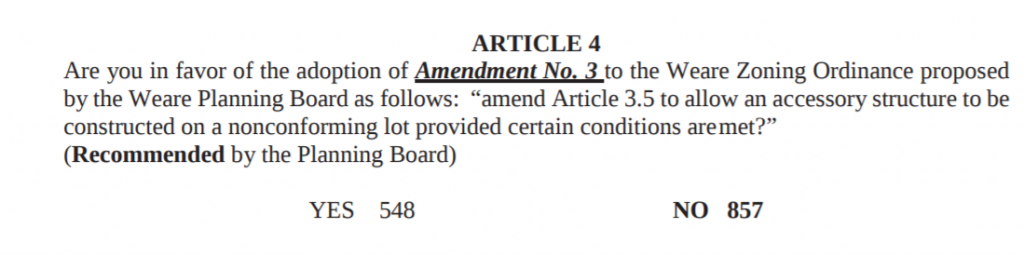
Mr. Dearborn’s extralegal use of these folk setbacks should have ended a second time – but again, did not – when Mr. Dearborn and Mr. Meany [ of the Planning Board ] had their warrant article #4 defeated in the election of 9 March 2021 with just 39% of the vote, barely half of what it needed to pass, given that there was a successful RSA 675:5 petition against it.
…but a second time, Mr. Dearborn refused to concede the point.
Mr. Dearborn revealed that he is still considers the extra legal folk setbacks to be real when he said at 17:20 in the meeting
“So when we make a motion we will say ‘no closer than’ … that’s how it works. If it’s closer than 30′ [ to the front ] or 15′ [ to the side ] then we have a problem.”
The 30′ and 15′ measurements are made up numbers, having absolutely nothing to do with either the actual zoning code setbacks for auxiliary structures (which are, as they have always been, 50′ and 25′), nor do they have anything to do with the limits of the ZBA’s variance power.
The ZBA can, if the five prongs are satisfied, issue a variance from the 50′ and 25′ setbacks. It can issue a variance allowing a building, if warranted, to intrude 6 inches into those setbacks, or it can issue a variance allowing a building, if warranted, to intrude 99% of the way into the setbacks.
Mr. Dearborn’s choice of words reveals that he is refusing to admit his defeat in the final order from the court on 10 December 2020, and is refusing to admit his defeat in the election of 9 March 2021, and is still working to back door legislate, at least in this case, his personal desire for the setbacks for auxiliary structures to be be 30′ and 15′.
The town lawyer should explain to the ZBA that the setbacks for auxiliary structures on non conforming lots were never 30′ and 15′, and are not now 30′ and 15′, and that the numbers 30 and 15 have absolutely nothing to do with the case before the ZBA. After the ZBA understands that the variance procedure does not exist to allow Mr. Dearborn overrule the zoning code, the voters of Weare, or judge William Delker in order to institute his own concept of the setbacks, the ZBA should rehear the variance application to remedy the flaws in the hearing of 4 May 2021.
18: improper site visits
The ZBA has had two improper site visits, and zero proper site visits.
The first site visit, on 8 December 2020 was, on information and belief, a sham site visit scheduled not for the purpose of gathering first hand information on the site, but as a maneuver to delay the variance hearing, originally scheduled for 1 December 2020, to a date in the following month, so that the Planning Board could convene a 10 December meeting and propose a warrant article with the avowed purpose of reversing the New Hampshire Superior Court’s ruling in TRAVIS CORCORAN, ET AL, Plaintiffs, vs. TOWN OF WEARE ZONING BOARD OF ADJUSTMENT, ET AL, Defendants.
There were several details which rendered the site visit improper and illegitimate.
- Mr. Dearborn, not a licensed surveyor, measured the distance between the barn and the property line using a tape measure, and came up with measurements that disagreed with the actual survey done by Meridian Land Services on 21 Jan 2019. I corrected Mr. Dearborn three times, citing the actual distances from the survey, but Mr. Dearborn was disinterested, did not make eye contact or respond to me, and repeated his tape measure numbers to the other members of the ZBA.
- Mr. Duquette then walked the ZBA to two corners of his house and said words to the effect of “that’s all of it”. I disagreed and pointed out that we had walked an area of land perhaps 90’ x 90’, and according to the deed that Mrs. Duquette attached to her variance application, the property is over 300 feet deep and approximately 300 feet wide.
- I asked Mr. Dearborn if we could walk the entire breadth and depth of the plot, and he ignored me. I asked a second time, and he ignored me. I then said “OK, I want to go on the record: I have asked twice now for the ZBA to actually walk the land and inspect alternate locations”. Mr. Dearborn responded “If we were talking about putting the barn back there, we would, but we’re talking about putting it here. Besides, I don’t want to traipse in the snow.”
These facts are documented in a letter sent to the ZBA approximately 30 minutes after the site visit ended, delivered with USPS tracking code 7020-0090-0001-6212-3964.
The second improper site visit was, based on Mr. Dearborn’s statements in the 5 May 2021 variance hearing, conducted by Mr. Dearborn alone, at some unspecified time, for the purpose of inspecting the grading and drainage between Mr. Duquette’s illegal structure and my property line.
By failing to announce the site visit ahead of time, and failing to invite abutters and other interested parties to attend and witness Mr. Dearborn’s investigative techniques, Mr. Dearborn violated RSA 91-A:2.
As Mr. Dearborn is not, to the best of my knowledge, a surveyor, or trained geotechnical or soils engineer, I am unclear on what techniques he used to evaluate the soil types, drainage, and slope but we do know from his statements in the meeting that he satisfied himself that the engineers and contractors that Mr. Manias of Concord Capital Appraisals consulted with were incorrect.
Had the site visit been conducted properly others could have witnessed Mr. Dearborn’s investigative techniques and critiqued them – and thus his attempt to help the variance applicant – in the variance hearing.
The ZBA should either hold a real site visit with advance public notice, where it inspects the entirety of the Duquette’s property (to gather information relevant to the “other reasonably feasible methods” branch of the hardship prong) and then rehear the variance application to remedy the flaws in the hearing of 4 May 2021, or it should admit the truth that the first site visit was a sham designed to buy time for an illegal attempted end run around a court order and that the second one was an illegal closed meeting, and update its minutes to reflect these facts.
19: improper second variance hearing by the ZBA
The variance hearing was improper because the ZBA already held such a hearing, in form if not in title. On 4 December 2018, despite the question before the board being merely one of definitions, the board treated what should have been an appeal of an administrative decision as a variance request in three ways:
First, Mr. Dearborn (chair of the ZBA) visited the site – something that’s not relevant for an appeal that was about the definition of one term, “single family residence”, but which is appropriate for a variance.
Second, Mr. Dearborn argued in the meeting in favor of construction because of unique details of the property. Unique details of the property are a core attribute of the variance process, but are entirely irrelevant to an appeal of an administrative decision. Mr. Dearborn’s arguments about the details of the property included quotes like “if he pushes it to the left, he’s gonna be into his driveway” and “because he has no access down over to the back” and – explicitly using the language of a variance proceeding – “it basically was a hardship fitting stuff onto the lot”.
Third, Mr. Dearborn ran the meeting as a variance meeting. Mr. Duquette, Mr. Meanie, and Mr. Carrera spoke, and not one of them addressed the zoning code – the ostensible point of the meeting – but instead addressed the public interest, the spirit of the ordinance, justice, value to the community, and hardship – the five prongs of the variance criteria.
Mr. Dearborn was paying attention to testimony and policing it to make sure it was restricted to topics that he wanted addressed – we know this because he terminated my testimony when I addressed section 3.5.1 of the zoning code – you can see this at 29:00 in the transcript. So Mr. Dearborn was very clear about what testimony was allowed and what was not, and he disallowed testimony that was relevant to an appeal of an administrative decision, but allowed three times, without interruption, testimony that was irrelevant to an appeal of an administrative decision, but was absolutely relevant to a variance process.
For these three reasons I suggest that the ZBA has already solicited and considered arguments on at all five prongs of the variance test, and it was improper to allow the Duquettes to have a second bite at the apple.
The ZBA should have a second hearing of the variance application, and immediately rule that a variance can not be issued because the variance process was already followed on 4 December 2018.